
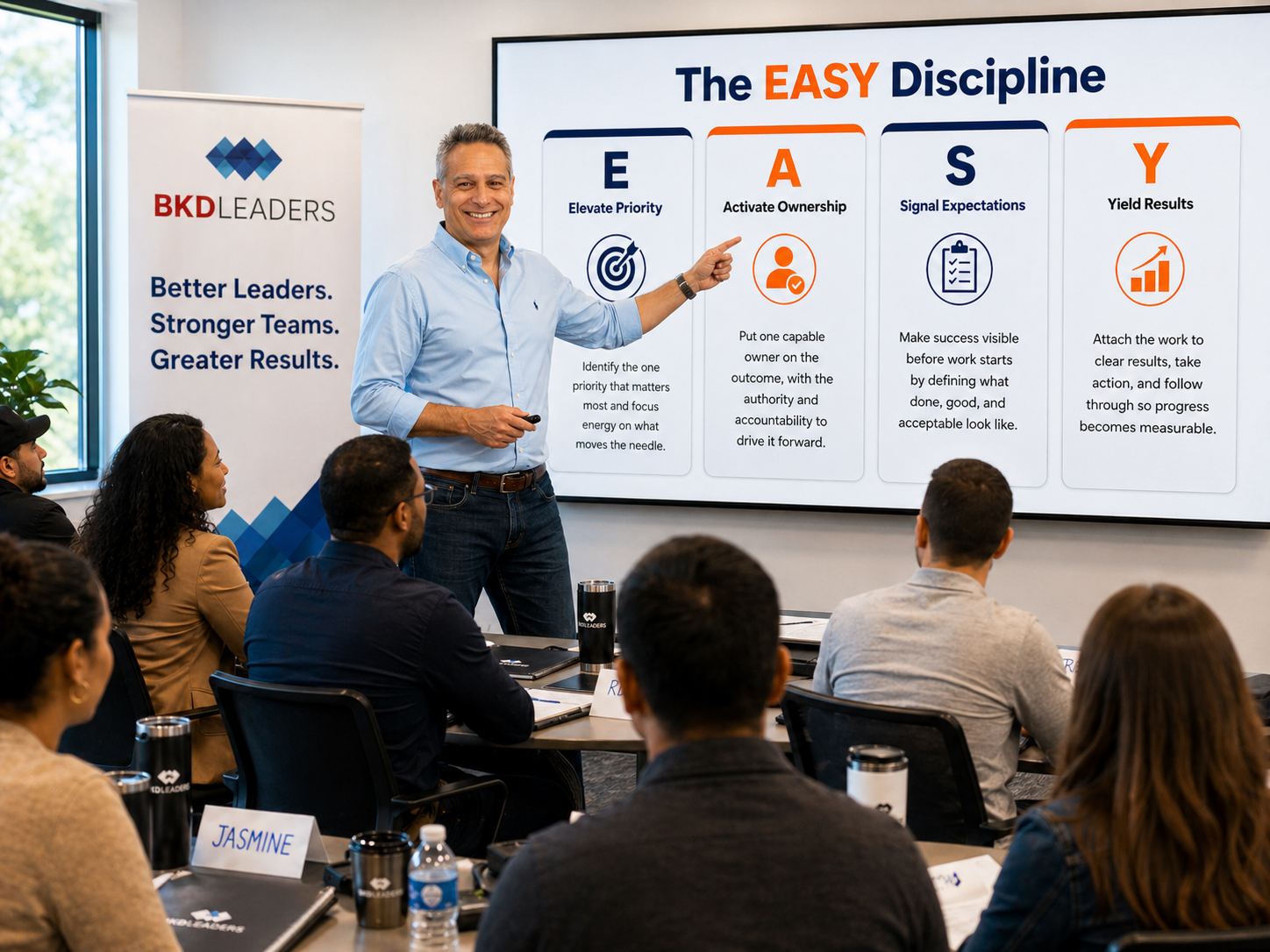
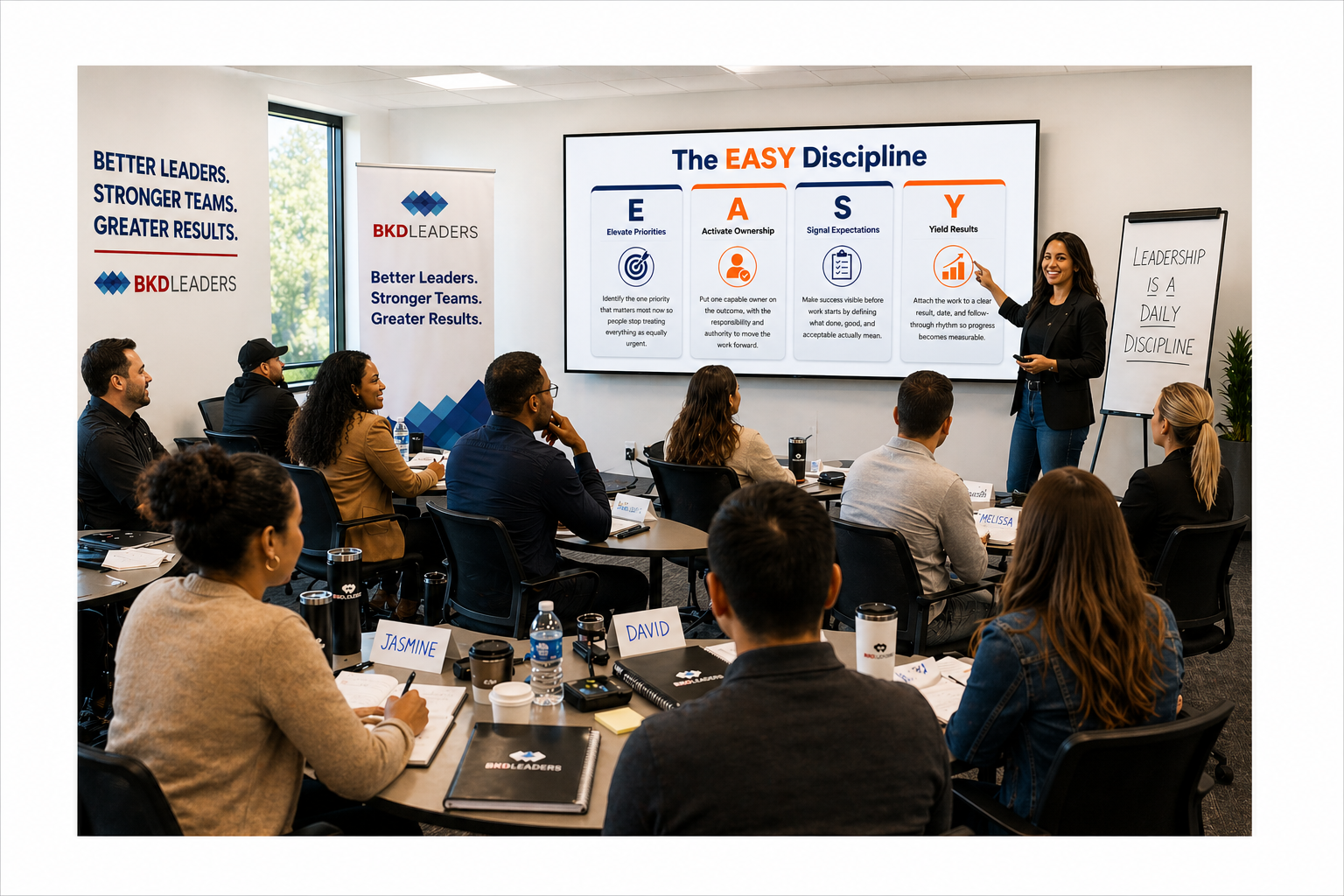
EASY is a daily leadership discipline for Owners, Executives, and Managers who need better results, stronger ownership, and more independence from the constant pull of the business.
EASY generates POWER — 1 Priority. 1 Owner. 1 Expectation. 1 Result.
The problem is that most leaders are trying to run the company through constant attention, repeated reminders, unclear priorities, and too much personal involvement.
They are chasing updates, fixing work, clarifying expectations, stepping into conflict, and carrying outcomes that should be owned by someone else. That kind of leadership feels necessary in the moment — but over time it creates HARD.
Everything feels important, so people struggle to know what matters most right now.
Work has participants, but not always one clear owner responsible for the outcome.
People guess what good looks like because expectations shift, stay implied, or arrive too late.
Work keeps moving, but results do not always have a clear date, measure, or finish line.
EASY moves leaders from friction and dependence into a simpler way to run work through Results, Ownership, and Independence.
Identify where priorities, ownership, expectations, and results are breaking down.
Connect the daily symptoms to business consequences — delay, rework, confusion, and weak follow-through.
Leaders learn a repeatable daily discipline: Elevate Priority, Activate Ownership, Signal Expectation, Yield Results.
When people know what matters, who owns it, what is expected, and what result is due — POWER returns to the work.
EASY is not a slogan. It is the daily leadership discipline that gives every person in the company the clarity to move work forward without waiting for direction.
When EASY is running, leaders stop over-managing and start leading. Meetings produce decisions. Managers move without being pushed. Owners get their time back.
No POWER = HARD. EASY fixes that.
1 Priority — so people know what matters most right now.
1 Owner — one person with clear responsibility for the outcome.
1 Expectation — a visible definition of what done and good look like.
1 Result — a measurable outcome with a date and a finish line.
Four words. One daily discipline. Used in meetings, one-on-ones, project updates, performance conversations, and everyday follow-through.
Identify the one priority that matters most now so people stop treating everything as equally urgent.
Put one capable owner on the outcome, with the responsibility and authority to move the work forward.
Make success visible before work starts by defining what done, good, and acceptable actually mean.
Attach the work to a clear result, date, and follow-through rhythm so progress becomes measurable.
Work gets connected to one priority, one owner, one expectation, and one result with a date.
People stop waiting for constant direction and begin taking real responsibility for outcomes.
Owners and Executives regain time because the business no longer needs them in every detail.
EASY is for Owners, Executives, Managers, and Supervisors responsible for getting work done through people.
It is especially useful when the same issues keep coming back, when people need too much direction, when ownership is unclear, or when leaders feel trapped in daily problem-solving instead of leading the business forward.
This is for leaders who need a discipline they can use immediately — in their next meeting, their next one-on-one, their next conversation about work that is stuck.
If running the company feels harder than it should, start by identifying where Results, Ownership, and Independence are breaking down.
EASY is not a model that lives in one workshop. It is the same four-lever discipline running on every level of work — installed on the priorities, owners, expectations, and results your team is already managing. The discipline is identical at every level. Only the scope of the work changes.
EASY does not change shape between the boardroom and the floor. The same four levers run on a CEO's strategic priority, an executive's monthly priority, a manager's weekly priority, and a front-line supervisor's daily move. That is what makes EASY a daily leadership discipline — it is built to be used by every leader, on every kind of work, every day.
For the priority that defines the next 90 days.
The Owner or CEO uses EASY to elevate the one strategic priority worth real attention this quarter, name the executive who owns it across functions, signal what success looks like at the enterprise level, and yield the result on a quarterly review.
For the priority that has to move this month.
The executive uses EASY to elevate the one functional priority for the month, activate the manager who owns the next move, signal what done looks like across the team, and yield a measurable result by the monthly review.
For the priority that has to move this week.
The manager uses EASY to elevate the one team priority for the week, activate one named owner per outcome, signal what right looks like before work starts, and yield a measurable result by Friday.
For the move that has to happen today.
The front-line supervisor uses EASY to elevate the one move that creates visible movement today, own the next step, confirm what right looks like, and show the proof by the end of the day.
This is not a discipline you read about and then carry into Monday morning. EASY is delivered through proprietary tools and assets that we install with you in the classroom — and that you and your team carry into the boardroom, the manager's office, and the daily huddle. The tools are how the discipline survives once the workshop ends.
They are designed to be installed with us, not figured out without us. The work is too specific, the levers are too sequenced, and the language is too precise to learn on your own. Companies that try to install EASY without the proprietary toolkit end up with the words but not the discipline.
The CEO leads strategic priorities. Executives lead functional priorities. Managers lead team priorities. Front-line supervisors lead daily moves. The whole organization moves on the same daily leadership discipline — and the work gets visibly easier at every level because clarity, ownership, expectations, and results stop being someone else's job.
Awareness. Alignment. Behavior change.
The right entry point depends on what is needed now. Every path uses the same proprietary tools applied to your real work, in the room.
Best for: one Owner, Executive, or Manager attending solo.
EASY applied to your most important current priority — and the language to bring it back to your team.
Best for: leadership teams, GM groups, manager cohorts (5–50 people).
A shared language and EASY already running on your most important priorities — with real owners and real results, not theory.
Best for: Owners and executives who want EASY running without them holding it together.
EASY as the permanent daily discipline — not a workshop memory. Results. Ownership. Independence. Running without Bryan in the room.
You are buying a daily leadership discipline that scales — from CEO strategy to front-line supervisor.
Work is harder to lead today than it was five years ago. The reasons are specific — and EASY is built to fix every one of them.
This is not a motivation problem. These are six structural forces making work harder to prioritize, own, and finish — and they are getting worse.
AI is changing what work looks like faster than leadership habits can adapt. Roles are shifting, priorities reset weekly, and leaders are making decisions about work that did not exist last year. The old operating disciplines do not work on new kinds of work.
The executive team has a strategy. By the time it reaches the manager layer, it has splintered into six different interpretations. Everyone is working hard on their own version of the priority list — and nobody agreed on which one mattered most this week.
The average knowledge worker is interrupted every 11 minutes and takes 23 minutes to return to full focus. Meetings, messages, and pings have made sustained execution nearly impossible. People are busy all day and finished with nothing at the end of it.
The brain processes one priority at a time with full cognitive power. Modern work demands parallel attention, constant context-switching, and real-time decision-making across a dozen open loops simultaneously. The result looks like poor performance. It is actually poor system design.
Shared accountability is no accountability. When work belongs to a team, a committee, or a group, everyone participated and nobody owned it. The work keeps moving until it stops — and by then, it is someone else's problem.
When the business depends on one or two people to hold everything together, those people stop leading and start executing. The business gets a worker when it needs a leader — and the owner pays for it in time, energy, and growth that never happens.
Work does not get hard because people stop caring. It gets hard because the business is running without a shared discipline — and EASY installs that discipline at every level.
Leadership losses are not equal across the org chart. Here is what it costs per role — and what EASY returns — when the discipline is installed.
| Role | Cost Savings | Cost Avoidance | New Business Capacity |
|---|---|---|---|
| Owner Founder / CEO $300K+ loaded |
$90K+
30% of time recovered annually
An owner spending 30% of their week inside operational decisions they should not own recovers $90K+ per year when EASY pushes those decisions to the right level.
|
$250K+
Business risk and replacement exposure
Owner dependence creates a single point of failure. EASY makes the business transferable, scalable, and less vulnerable — removing the most expensive risk on the balance sheet.
|
Uncapped
Strategic capacity fully returned
Every recovered hour is available for new client development, strategic partnerships, acquisition, or growth. Only the owner can do that work — and right now, most owners are too busy to do it.
|
| Executive VP / C-Suite / Director $280K loaded |
$56K+
20% of time recovered annually
At a $200K salary with a 1.4× loaded cost of $280K, an executive recovering 20% of their week from repeated escalations, re-briefings, and unclear ownership saves $56K per year — per executive.
|
$80K+
Per avoided executive departure
High performers leave unclear organizations first. EASY removes the ambiguity that drives voluntary executive turnover — and replaces an $80K+ replacement cost with a retention result.
|
$200K+
Per initiative executed without rework
When strategic initiatives execute cleanly — with one owner, one expectation, one result — the value of each compounds. One clean execution can return multiples of the EASY investment alone.
|
| Manager Team Lead / Supervisor $105K loaded |
$16K+
Per manager per year recovered
At a $75K salary with a 1.4× load of $105K, 8 hours of weekly work on status chasing, repeated clarification, and rework equals $16K+ in recoverable annual productivity per manager.
|
$28K+
Per avoided project failure or delay
Unclear expectations and missing ownership are the most common and most expensive failure mode at the execution layer. EASY eliminates both before work starts.
|
2–3×
Team output multiplier
A manager running EASY produces a team that moves faster, owns more, and requires less oversight — multiplying their personal output into team-level results without adding headcount.
|
| Employee Individual Contributor $63K loaded |
5 hrs/wk
Recaptured from wrong-direction work
Employees working inside unclear priorities and missing expectations lose 4–6 hours weekly to work that comes back wrong, waits for clarification, or never connects to a result anyone tracks.
|
$18K+
Per retained employee annually
Unclear expectations are the leading driver of voluntary disengagement and departure. EASY removes the ambiguity that makes good people disengage — and keeps performers who would otherwise leave quietly.
|
Owned
Work becomes owned, not just done
When employees have one clear priority, one clear expectation, and one result — they stop participating in work and start owning it. That behavioral shift is the real return at this level.
|
Loaded cost assumes 1.4× base salary including benefits, overhead, and management time. Figures are illustrative based on industry-standard productivity and turnover research.
Sending one leader to a training produces awareness. Installing EASY across a team, division, or company produces a shared operating language — and that is where the return compounds.
Scale estimates assume 100-person company with standard industry compensation. Actual returns depend on org size, compensation levels, and depth of install.
These are the most common shifts leaders and teams experience once EASY becomes the daily operating discipline.
These are the highest-impact problem types EASY has been deployed to solve — across industries where running without a shared discipline was costing the business more than anyone had measured.
Start with the EASY Assessment to identify where Results, Ownership, and Independence are breaking down — then schedule time to discuss the right installation for your team.